Understanding Heavy Duty Corrugated Boxes
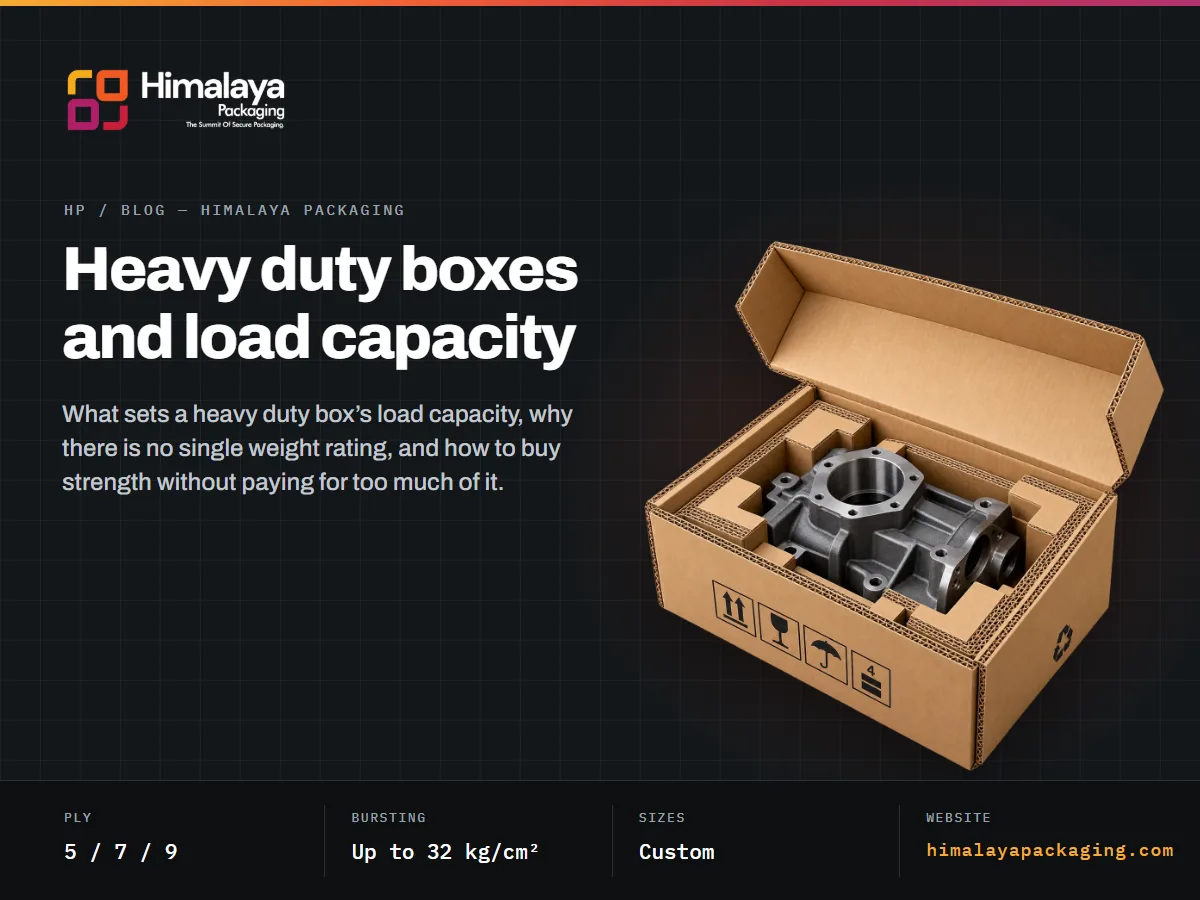
A heavy duty corrugated box is built from multi-wall board — 5, 7 or 9 ply — for loads that would crush, puncture or burst a standard carton. Load capacity is what you are buying, and it depends as much on how the box is stacked, stored and shipped as on the board itself.
What makes a box heavy duty
A heavy duty box has more fluted walls and heavier papers than a standard carton. Each extra wall adds stiffness, stacking strength and puncture resistance. The ply tells you how many walls there are:
| Ply | Walls | Typical heavy duty use |
|---|---|---|
| 5 ply | Double | Most industrial loads and general engineering parts |
| 7 ply | Triple | Heavy castings, machinery parts, high pallet stacks |
| 9 ply | Quadruple | The heaviest loads and long export routes |
Multi-wall boards also combine flute profiles — for example B and C together — to balance stacking strength against puncture resistance from sharp-edged parts.
What load capacity depends on
There is no single weight a heavy duty box “holds”. The same box can carry a load safely for a week on a dry floor and fail in a month in a humid store. Load capacity depends on:
- The board — its ply, paper grades and flute combination.
- The box size. Most of a box’s stacking strength is in its walls and corners, so its footprint and height change what it can carry.
- Moisture. Board absorbs moisture from humid air and loses compression strength as it does.
- Time under load. Board under a constant load slowly creeps, so a box stacked for months needs more margin than one stacked for a day.
- How it is stacked. Boxes stacked corner on corner are stronger than boxes stacked in an interlocked pattern, and a box overhanging the pallet edge loses strength.
This is why packaging engineers allow a safety margin between what a box can carry in a test and what it is asked to carry in a warehouse — and why we specify from the load, the stack and the route rather than from a weight rating alone.
Affordable without under-specifying
A heavy duty box is affordable when it is exactly as strong as the job needs. Over-specifying wastes board on every order; under-specifying costs far more in damaged parts, rejected consignments and re-shipping. Getting it right usually saves money in three places:
- The right ply for the load and route, not the heaviest board by default.
- The right size, so the box carries the part rather than air — less board, and less room for the load to move.
- Fitted inserts instead of loose filling, so the part is held and the box works as one unit.
What to consider when choosing a heavy duty box
- Weight and weight distribution — a concentrated load on a small base behaves differently from an even one.
- Dimensions and shape, including any sharp edges or protrusions.
- Stacking height and duration in your warehouse and your customer’s.
- Route and handling — forklift or manual, road or sea, how many transfers.
- Environment — humidity, sea freight, storage on arrival.
Where heavy duty boxes are used
Castings and forgings, machinery parts, pumps, motors and gearboxes, and anything that goes onto a high pallet stack or a long export route. See how we specify for automotive components and engineering and machinery, and our export and industrial boxes for sea freight.
Heavy duty boxes from Himalaya Packaging
We make heavy duty boxes in 5, 7 and 9 ply, with bursting strength up to 32 kg/cm², die-cut inserts and partitions, and print in up to four colours — all in our plant in Bakrol Bujrang, Ahmedabad. Send the part weight, stacking height and route, and we come back with a board specification and a delivered price. You test a physical sample with your own part before any bulk run. See our heavy duty boxes.
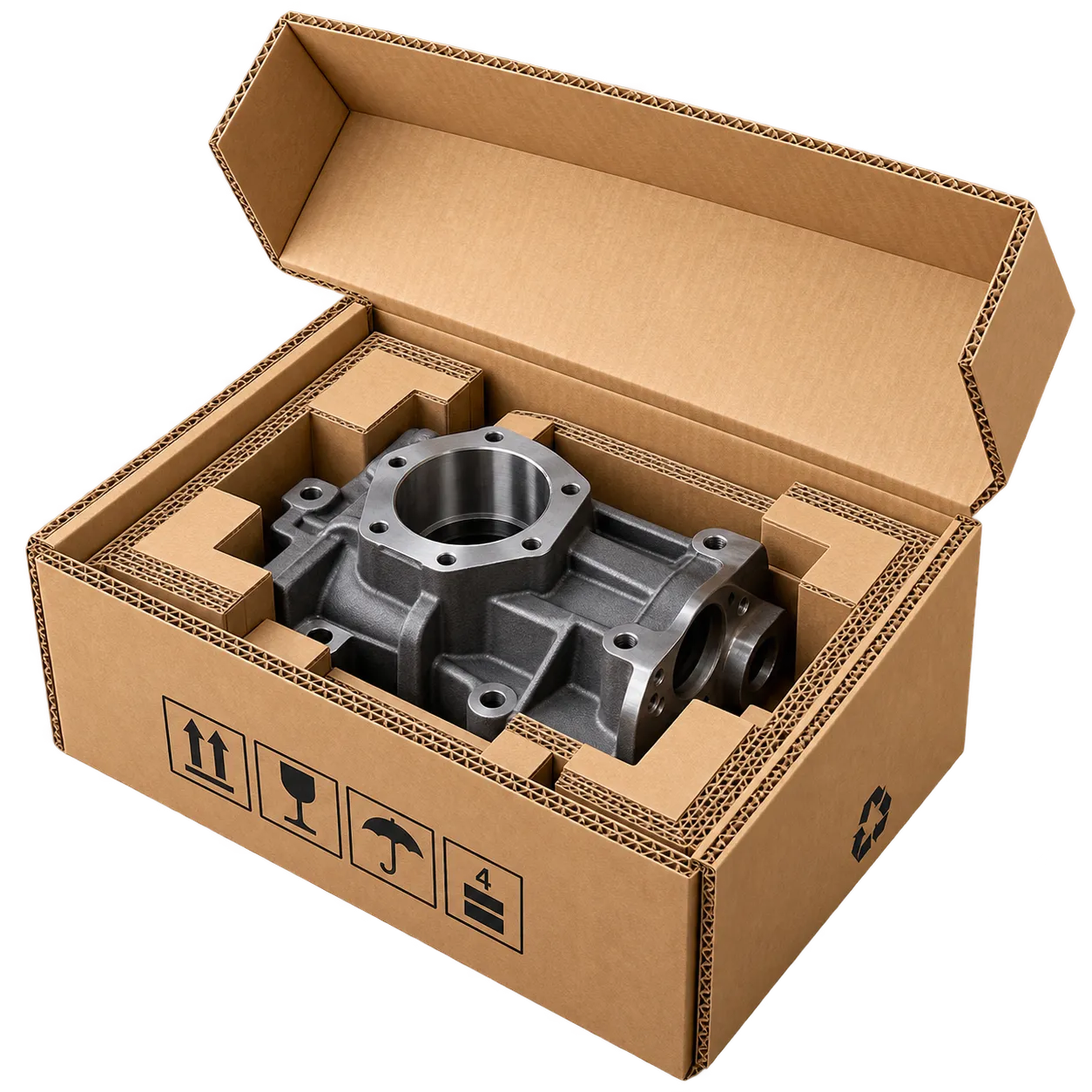 The product behind this article
Heavy Duty Boxes
For castings, machinery parts and any load that would crush a standard carton.
5–9 ply
to 32 kg/cm²
Custom sizes
The product behind this article
Heavy Duty Boxes
For castings, machinery parts and any load that would crush a standard carton.
5–9 ply
to 32 kg/cm²
Custom sizes