Understanding Corrugated Boxes and Their Importance
Corrugated boxes carry most of what moves through Indian industry and trade — components to the assembly line, tiles to the dealer, cartons of goods to the warehouse. The same material serves industrial and commercial packaging, but the specification is very different, and most box failures begin with choosing the wrong one.
How a corrugated box is built
Corrugated board is paper in layers: flat liners on the outside, glued to a fluted layer — the medium — in between. The fluted layer is what makes corrugated work. It keeps the liners apart, so the board is stiff and resists crushing, and it cushions the contents against knocks.
Adding fluted layers adds strength. The number of paper layers is the ply, and it is the first line of any box specification:
| Ply | Walls | Typical use |
|---|---|---|
| 3 ply | Single | Light goods, inner cartons, short local routes |
| 5 ply | Double | Most industrial loads and general engineering parts |
| 7 ply | Triple | Heavy castings, machinery parts, high pallet stacks |
| 9 ply | Quadruple | The heaviest loads and long export routes |
Key benefits of corrugated boxes
- Strength for the weight. The fluted structure carries stacking loads that would need far heavier material in another form.
- Made to size. Boxes are cut to the product, so there is less empty space to fill and less movement in transit.
- Printable. Brand, product details and handling marks go straight on the box.
- Delivered flat. Boxes are stored flat until they are needed on the packing line.
- Paper-based. Corrugated is widely recycled, and recycled fibre goes back into new board.
Corrugated boxes for industrial packaging
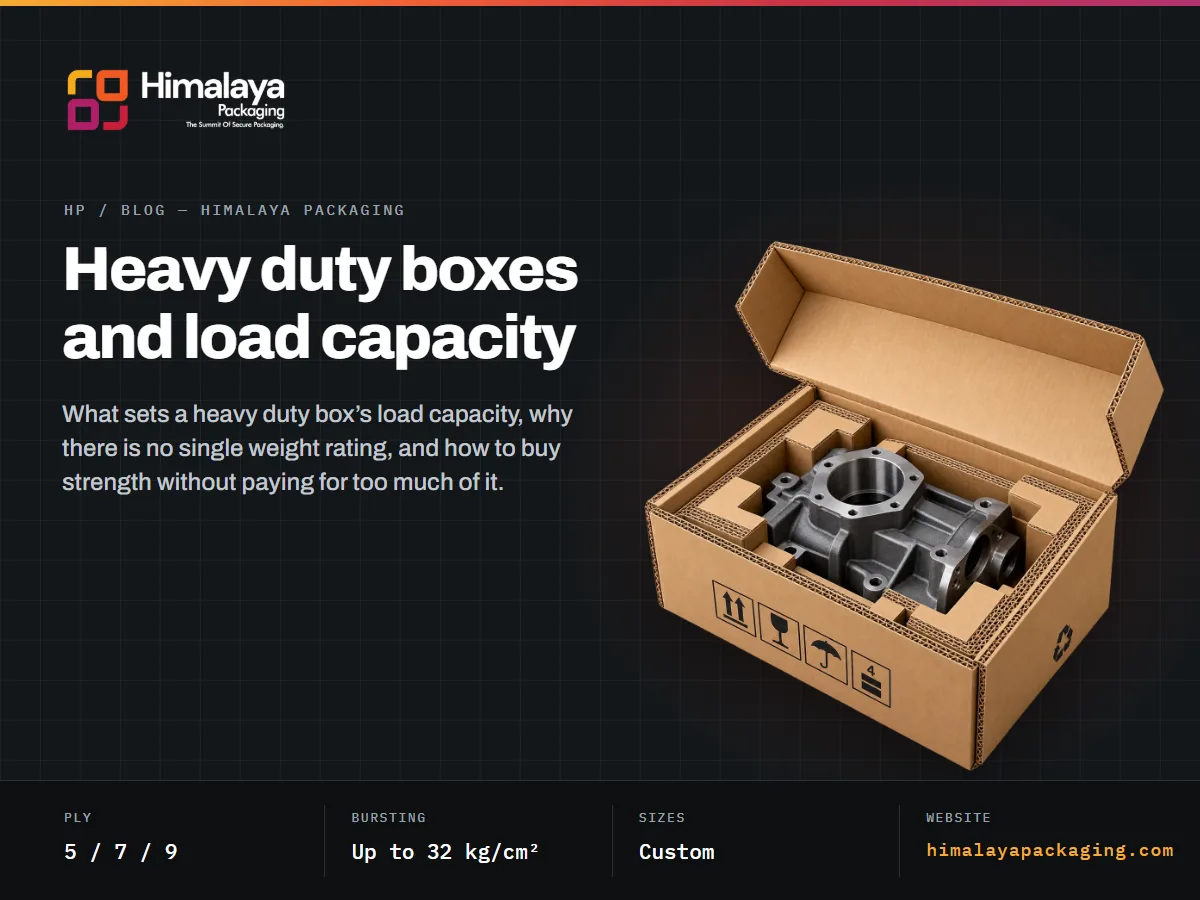
Industrial loads are heavy, dense, often sharp-edged and rarely a standard shape: castings, machined parts, pumps and motors, automotive components, electrical equipment. They are stacked high in warehouses and moved by forklift. Boxes for them usually need 5 to 9 ply board, die-cut inserts or partitions that hold each part in position, and a footprint planned around the pallet.
Read more on heavy duty boxes, or see how boxes are specified for automotive components and engineering and machinery.
Corrugated boxes for commercial packaging
Commercial packaging moves finished goods through distribution: shipper cartons to distributors, branded outer boxes, and shipping cartons for heavier online orders. The loads are lighter, so 3 and 5 ply boards are common, and print carries more of the job — brand, product and handling information. Small retail cartons and mailers are a different product; we supply those through our other website, boxmanufacturers.co.in.
What quality means in a corrugated box
“Good quality” is only useful if it can be stated and checked. These are the measures that describe a corrugated box:
| Measure | What it tells you |
|---|---|
| Board grade (GSM) | The weight of each paper in the board, in grams per square metre |
| Bursting strength | The pressure, in kg/cm², the board takes before it ruptures |
| Edge crush | The load the board carries on its edge — the basis of stacking strength |
| Box compression | The load a finished box takes before it buckles |
| Moisture | Board loses compression strength as it absorbs moisture |
Just as important is consistency: the box you receive on the tenth order should match the one you approved on the first. That comes from a written specification that every repeat order is made to.
Customisation and branding
- Printed logos, product details and handling marks, in up to four colours
- Die-cut profiles, partitions and fitted inserts
- Handle cut-outs for boxes that are carried rather than palletised
- Lamination on printed faces
Corrugated boxes from Himalaya Packaging
We make corrugated boxes from 3 to 9 ply at our plant in Bakrol Bujrang, Ahmedabad, for industrial and commercial buyers across India. Ply, board grade, flute and bursting strength are agreed in writing, you approve a physical sample before bulk production, and every repeat order is made to the same specification. Our capabilities page sets out the full range.
 The product behind this article
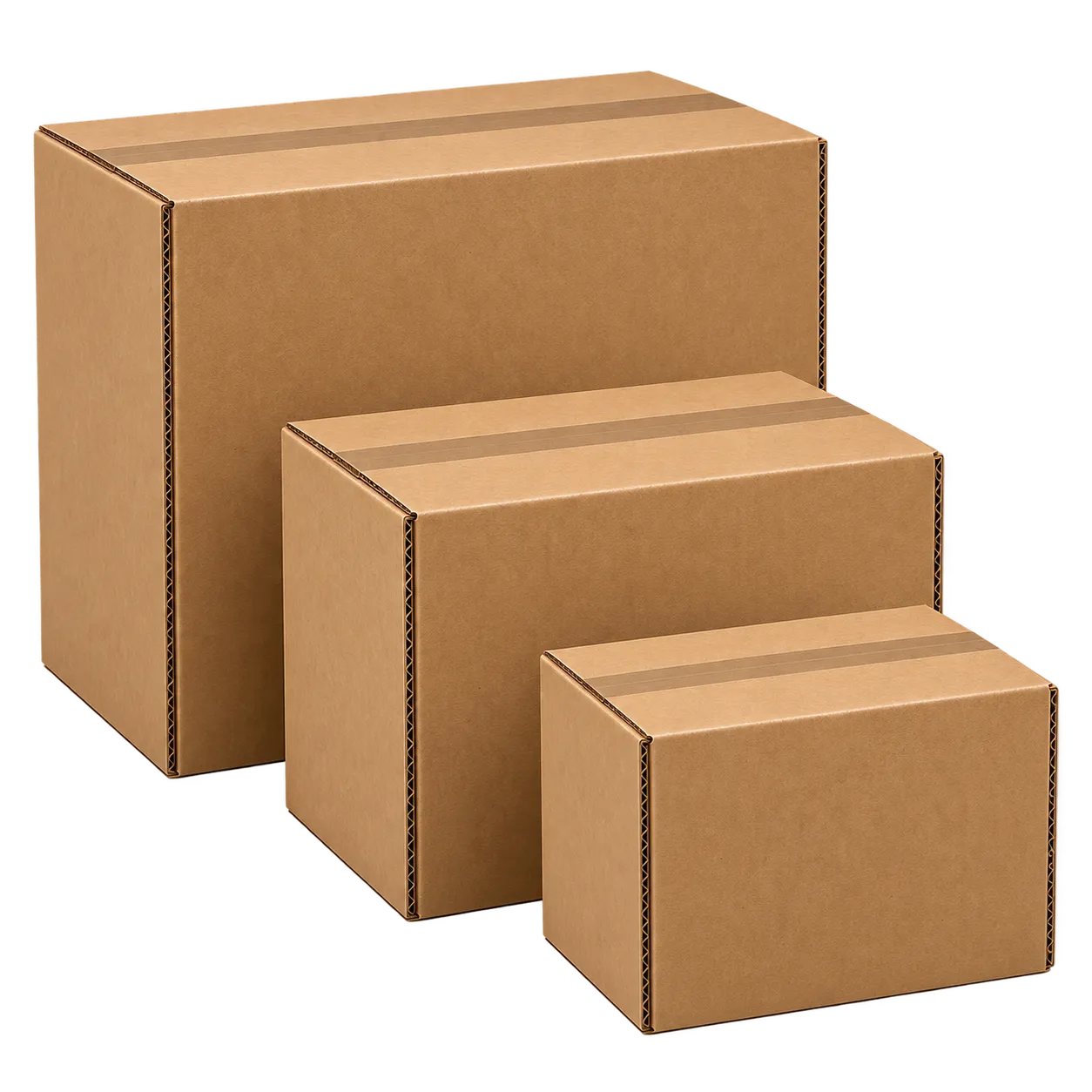
Corrugated Boxes
The workhorse range, specified to the load rather than sold off a standard size list.
3–7 ply
A/B/C/E flute
120–250 GSM
The product behind this article
Corrugated Boxes
The workhorse range, specified to the load rather than sold off a standard size list.
3–7 ply
A/B/C/E flute
120–250 GSM